
Belts
A belt is a length-control product as much as a design product. Strap straightness, hole spacing and buckle alignment determine whether it hangs correctly.
Constructions
- Cut-edgeSingle-layer strap, edge painted or burnished; the cleanest look.
- StitchedTwo layers bonded and stitched, with or without edge paint.
- ReversibleTwo leather faces, rotating buckle; requires precise strap symmetry.
- BraidedWoven leather strips around a core, with leather or metal ends.
Buckles are sourced in the finish specified by the customer or developed from a drawing. Screwed constructions allow replacement and repair.
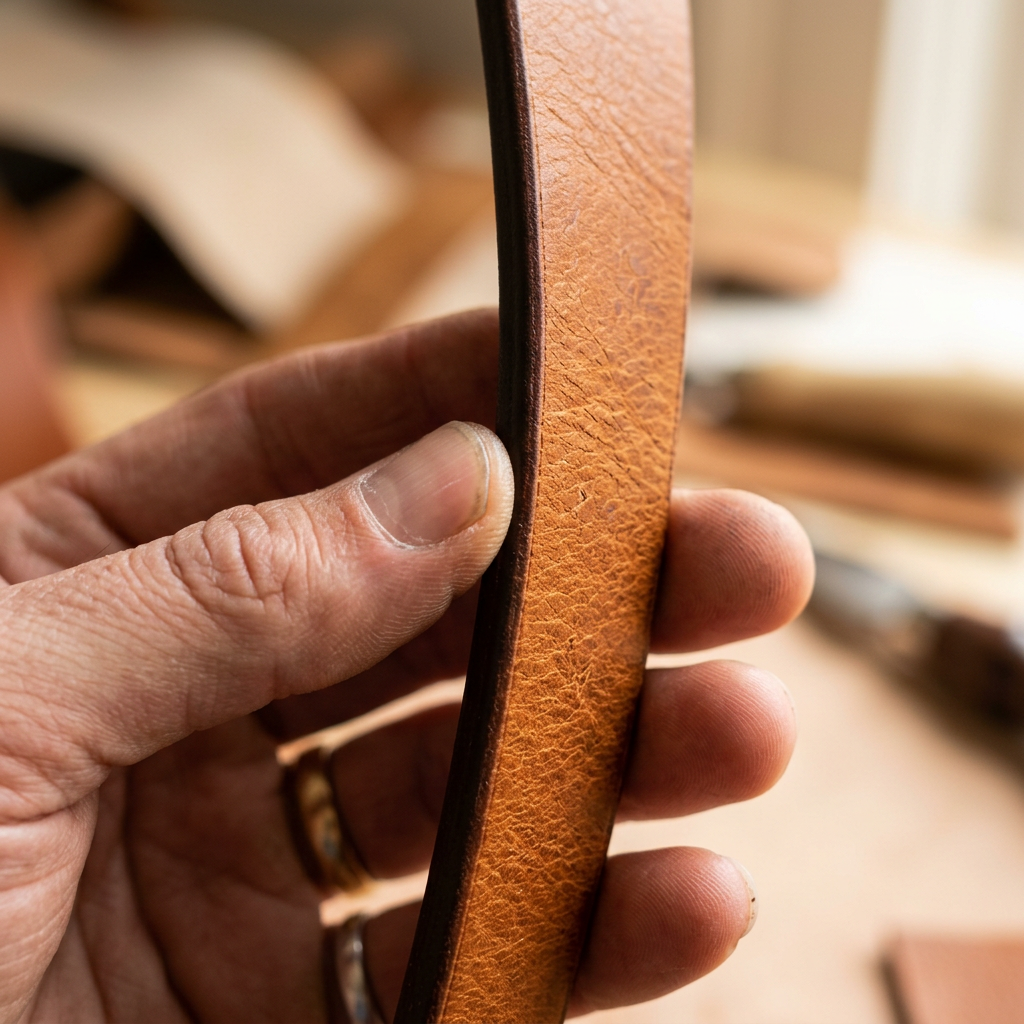
Strap straightness is checked before punching; a 1 mm drift is visible when worn. Illustrative image.
Belt parameters.
| Parameter | Typical spec | Control |
|---|---|---|
| Strap width | 25 / 30 / 35 / 40 mm | Cut width and edge finish |
| Leather thickness | 3.0–4.5 mm single layer | Thickness gauge, incoming |
| Length | Size graded to customer chart | Measurement against size chart |
| Hole spacing | 25 mm standard [TBC] | Template and punch check |
| Buckle | Pin, plate, automatic, reversible | Function and finish |
| Edge | Painted, burnished or raw | Coating uniformity |
| Stitching | Optional; thread to match or contrast | Tension and line straightness |
Size charts are customer-specific. We recommend approving a physical size set before bulk punching.
Production notes
Strap selection
Hide position matters: belly and shoulder areas behave differently after wear. Strap blanks are selected for straightness and density.
Buckle setting
Riveted, screwed or stitched, the buckle must sit square. We check alignment on a flat surface, not by eye.
Finishing
Edge paint on a 4 mm strap needs multiple thin coats. Rushed finishing is the most common cause of cracking.